

Osmanthus in Skincare: The Autumn-Blooming Flower Behind a Perfume-Grade Face Balm
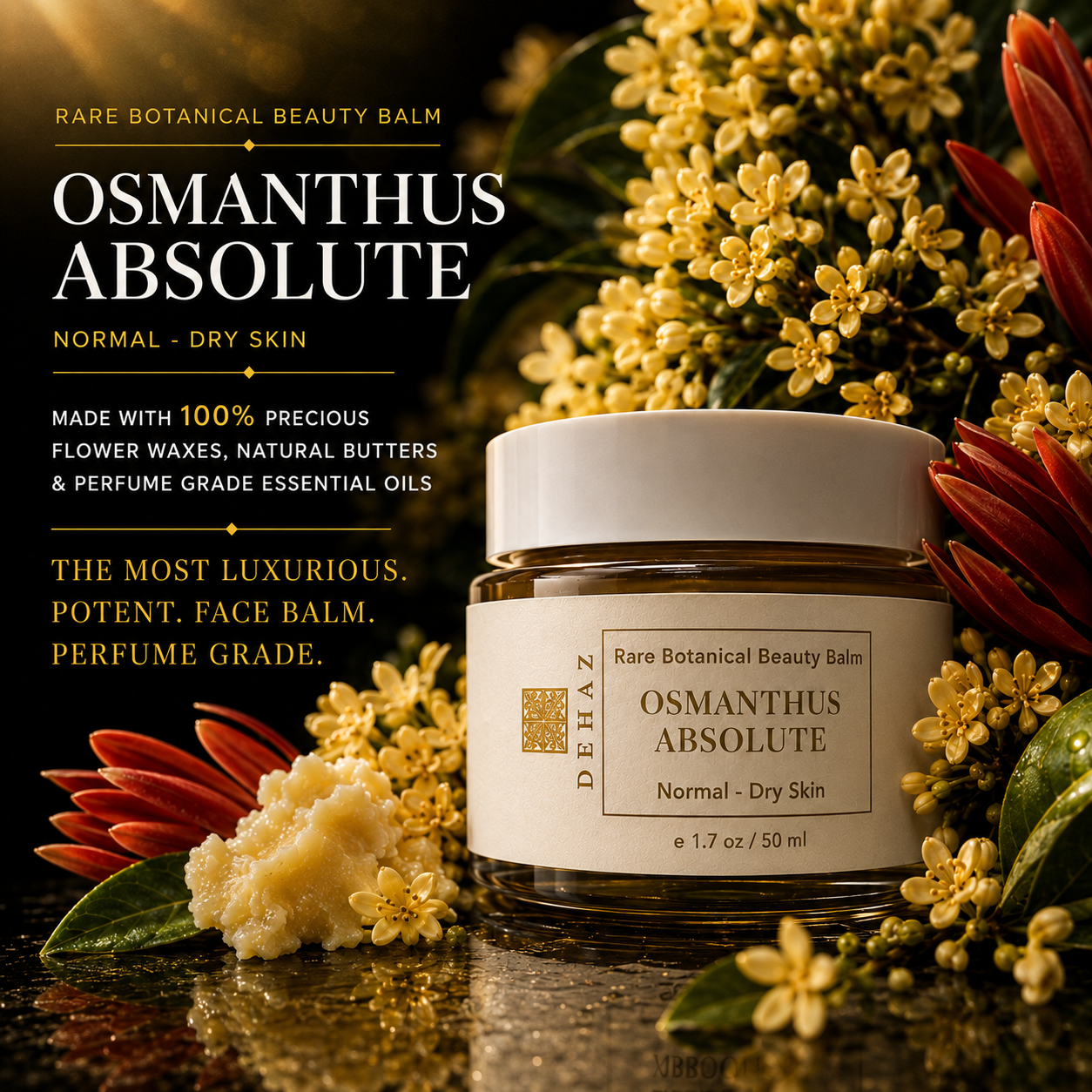
Sweet osmanthus (Osmanthus fragrans) waits until late summer and autumn to flower, and when it does the blossoms are almost comically small: tiny golden clusters tucked along the branch. The scent is another matter. It is usually described as ripe apricot or peach, with a honeyed, tea-like warmth, and it carries much farther than the flowers' size would suggest.
That scent is why osmanthus has been a fixture of Chinese gardens, tea blends and perfumery for centuries. It is also why a formulator might build a face balm around it. In short: osmanthus is a fragrant flowering shrub whose blossoms are used in skincare as an absolute, a concentrated aromatic extract, and OSMANTHUS ABSOLUTE — Rare Botanical Beauty Balm for Dry & Very Dry Skin is DEHAZ's rich, waxy interpretation of it for dry and very dry skin.
What is osmanthus, and what does it do in skincare?
The plant is native to a broad arc of Asia that includes China, Japan, the Himalayas, Taiwan, Thailand and Vietnam. In China it has been cultivated for roughly 2,500 years, first in imperial gardens, and today it is the official city flower of Hangzhou, Suzhou and Guilin. The flowers season tea, preserves, pastries and wine, which tells you something about how pleasant the aroma is when it is not trying to compete with anything.
For skin, the interest is partly aromatic and partly botanical. Laboratory work on osmanthus flower extracts has found a rich mix of plant polyphenols, including rutin and verbascoside, and an ethanol extract of the flowers showed strong antioxidant capacity in test-tube assays and reduced nitric oxide in a cell model of inflammation. That is early-stage, in vitro research on extracts rather than on finished creams, so it is best read as a reason formulators find the flower interesting, not as a promise about any particular product. On the DEHAZ product page, osmanthus absolute is described as antioxidant-rich and as helping skin look smoother, more elastic and more radiant.
Absolute, essential oil, extract: what the label is telling you
An essential oil is typically made by distillation or pressing. An absolute is made by solvent extraction. The flowers are first extracted with a solvent to produce a waxy, fragrant material called a concrete; the concrete is then washed with ethanol, chilled so that waxes solidify, filtered, and the ethanol is evaporated off, leaving the absolute. Absolutes carry a high concentration of aromatic compounds and are less volatile than essential oils, which is why perfumers lean on them for delicate flowers like jasmine that do not give up their scent easily to distillation.
Why does that matter on a skincare label? An ingredient listed as "Osmanthus Fragrans Absolute Oil" is the perfumer's version of the flower, closer to the fragrance material than to a water-based extract. It is also a reminder that a floral-scented balm made with real absolutes is, practically speaking, a fragrance product as well as a moisturizer, which is worth knowing if your skin has opinions about aroma.
Flower waxes: an unusual foundation for a face balm
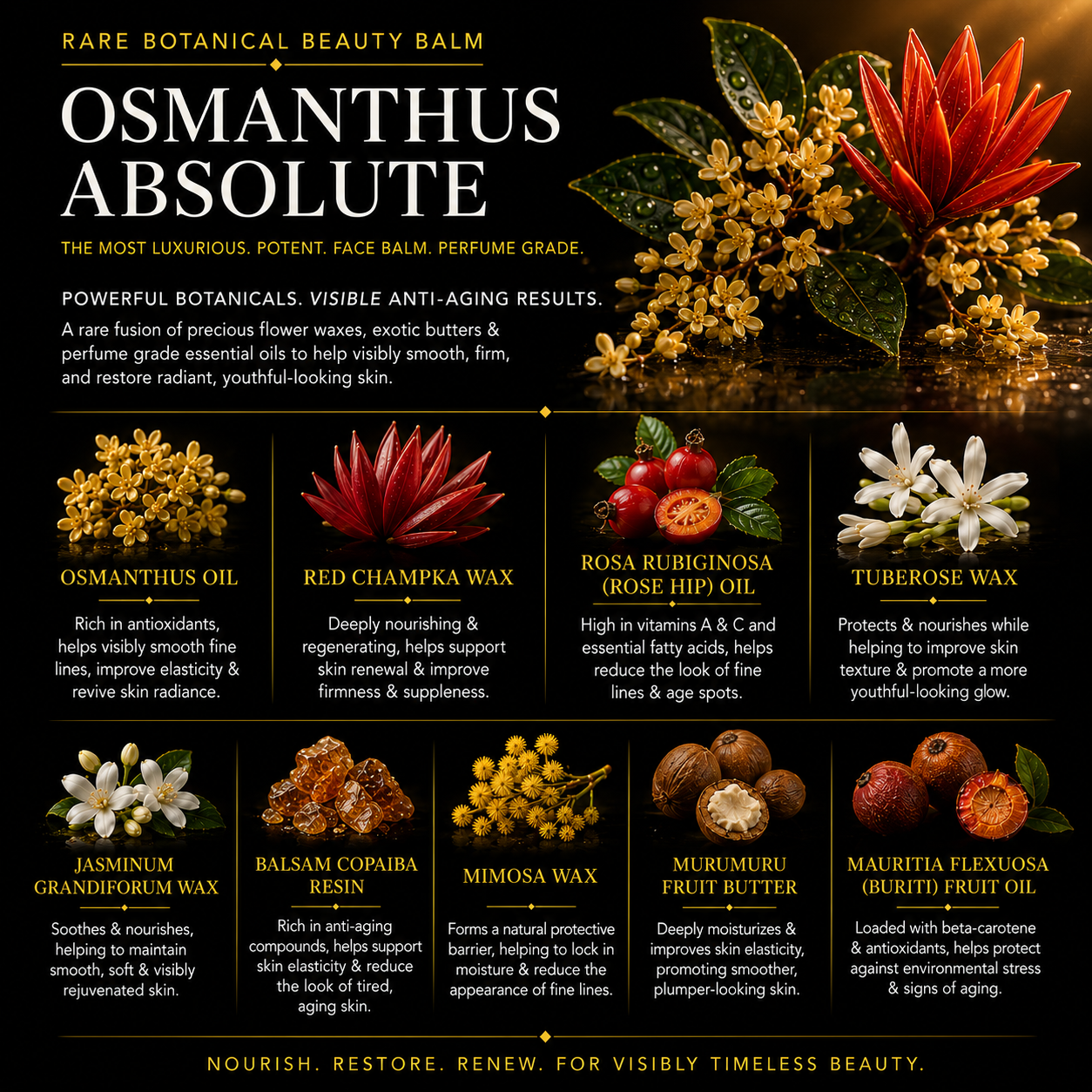
Most balms are built on butters and plant oils. Osmanthus Absolute starts there too, with shea butter, olive wax and tucuma butter, and then does something less common: it brings in the waxes of flowers. Red champaca wax, tuberose wax, jasmine (Jasminum grandiflorum) wax and mimosa wax all appear in the ingredient list, alongside osmanthus absolute itself.
The ingredients are chosen for what they do as well as how they smell. According to the product page, red champaca wax is deeply nourishing and supports the look of firmness and suppleness; tuberose wax helps protect and nourish while improving the look of texture; jasmine wax helps soothe and nourish; and mimosa wax forms a natural protective veil that helps lock in moisture, which is the reason it suits skin facing harsh, drying weather.
The pairing at the center of the formula is osmanthus with red champaca. Each was brought in for two reasons at once: the properties that benefit skin showing visible signs of aging, and the ability to build an intoxicating natural fragrance. In the finished balm that fragrance reads as apricot and honey meeting spice and balsam, brightened by white jasmine and tuberose and grounded by copaiba resin. There is no added synthetic fragrance; the scent comes from the flower waxes and absolutes themselves.
The butters and oils that give the balm its cushion
A balm for very dry skin needs more than aroma. The formula adds murumuru butter, an Amazonian palm butter that the page credits with deeply moisturizing extremely dry skin, and buriti fruit oil, the orange-red oil pressed from the fruit of a palm native to wet areas across tropical South America. Buriti is traditionally used in hair and skin care and is known for its carotenoids, especially beta-carotene. Rosehip oil and cloudberry oil add further fatty acids, and balsam copaiba resin contributes the grounding, resinous note along with its reputation for supporting the look of elasticity and tired-looking skin. For more on how botanical oils have been studied and used, see DEHAZ's article on the clinical evidence for Moroccan beauty oils.
If you read the full ingredient list you will notice how many fruit and seed oils are tucked in toward the end: arctic cranberry, sea buckthorn, andiroba, yangu, immortelle, linden flower. They contribute less by volume and more by character, and they are part of what keeps the balm from reading as a single-note wax.
How Osmanthus Absolute feels, smells and wears
This is a dense balm, and it behaves like one. You scoop a small amount with clean fingertips and warm it between them until it melts, then press it gently into the face and neck, spending a little longer on areas of visible dryness. The directions on the page call for morning and evening use before moisturizer, and the page also describes it as a natural final step in a fuller ritual, especially in the evening, so it can be placed as the first or the last layer depending on how you like to build your routine.
It is formulated for dry and very dry skin, including skin that lives with cold, wind, low humidity, dry heat or altitude. The page notes that many people see an improvement in softness, hydration and radiance with consistent use over several weeks as part of a complete routine. If your skin is oily or combination, DEHAZ suggests talking to your esthetician about how to place a balm this rich in your regimen; our guide to balancing oily and dry skin naturally is a useful companion. Store the jar in a cool, dry place, out of direct sunlight, and keep the lid closed.
Building a dry-skin ritual around the balm
Osmanthus Absolute is the richest option in its neighborhood, but very dry skin rarely needs just one product. These DEHAZ products overlap in purpose and differ in texture and role.
| Product | Texture and role | How it relates to the osmanthus balm |
|---|---|---|
| Osmanthus Absolute | Dense, waxy balm built on flower waxes, butters and oils; for dry and very dry skin | The rich, lipid-heavy layer |
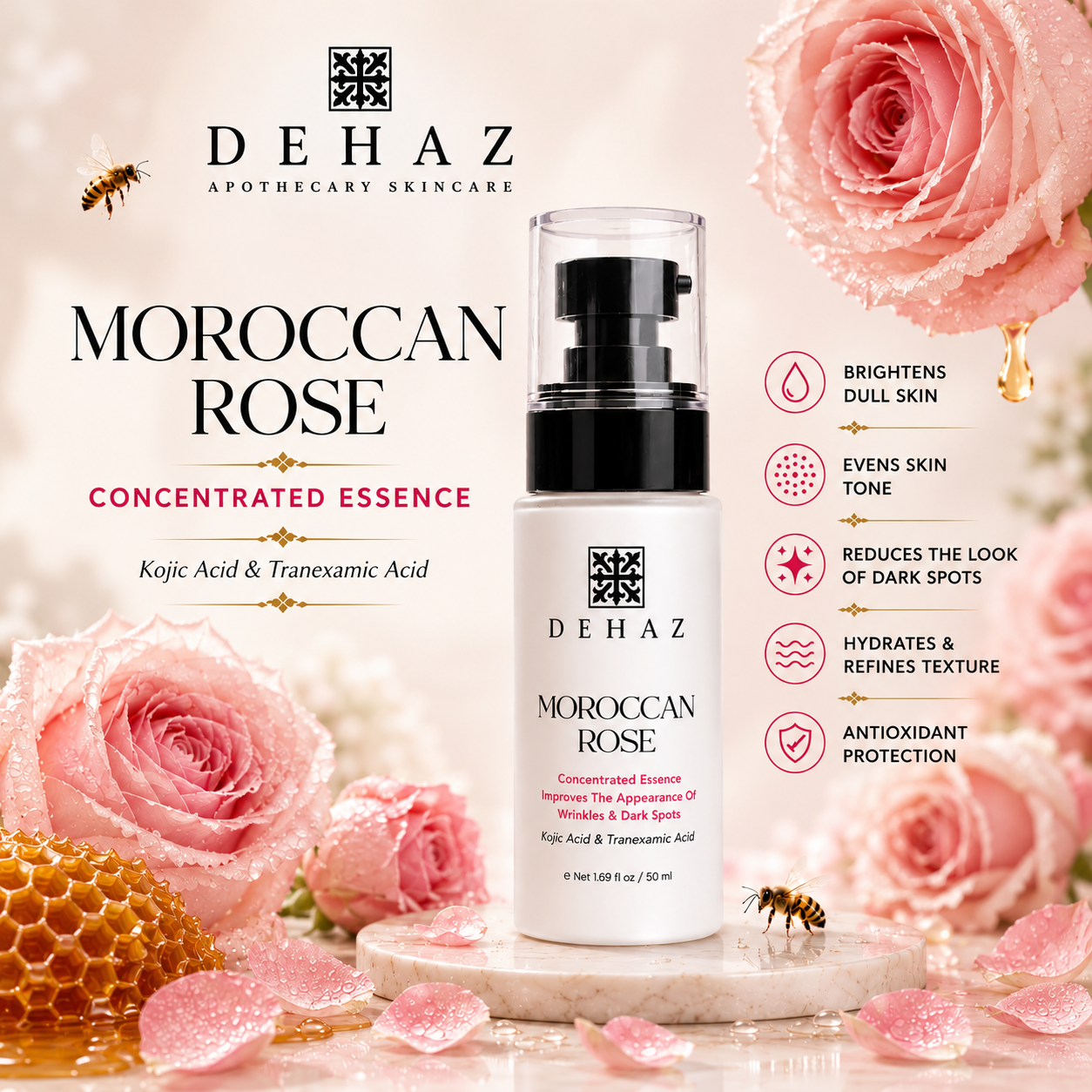
| Moroccan Rose Essence Serum | Lightweight essence serum on a rose-water base, with tranexamic acid, niacinamide and licorice root; applied after cleansing and toning | A hydrating, radiance-minded layer beneath oils, creams or balms |
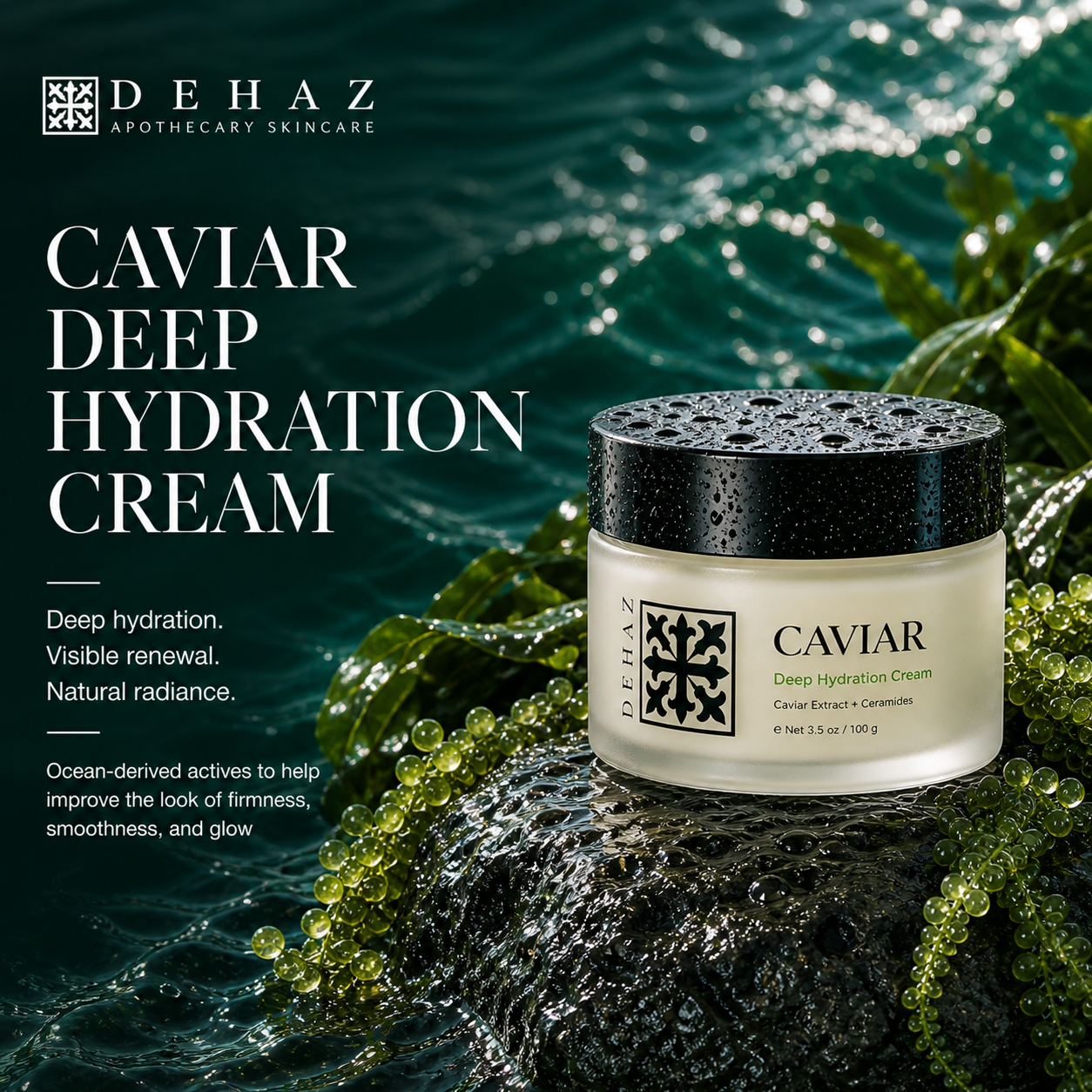
| DEHAZ Triple Caviar Deep Hydration Cream | Rich cream with three caviar oils, marine peptides and multi-molecular hyaluronic acid, designed to absorb without a heavy or occlusive feel; for very dry and dehydrated skin, used morning and evening | A plumping, hydration-focused moisturizer for readers who want moisture as well as cover. It also lists osmanthus oil among its ingredients |
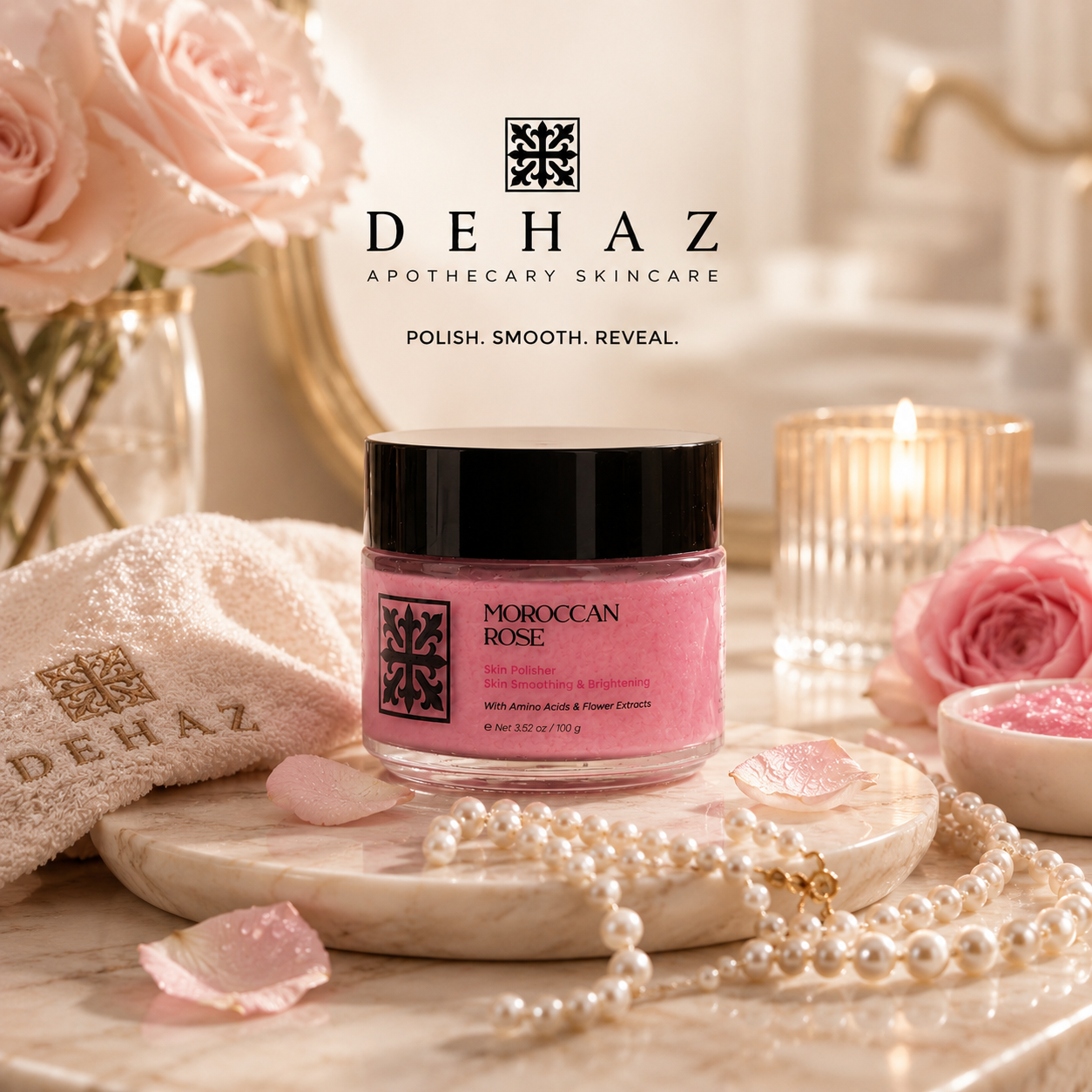
| DEHAZ Moroccan Rose Skin Polisher | Gentle polish with finely milled walnut shell powder, rose and centella, used on damp skin one to two times per week | A weekly preparatory step: the page positions it as a way to help the products that follow absorb more effectively |
A practical way to build around it: cleanse, tone, apply a hydrating layer such as the Moroccan Rose Essence Serum, and finish with the balm. Once or twice a week, the Moroccan Rose Skin Polisher can come in ahead of the serum to lift surface buildup, using light circular motions and minimal pressure. The page recommends a patch test first, particularly for skin that looks and feels sensitized. Readers who prefer a cream texture to a balm can look to the Triple Caviar Deep Hydration Cream. If you like to understand the order of operations, DEHAZ's guide to layering botanical skincare products walks through it. The full range of finishing products lives in the DEHAZ moisturizer collection.
For estheticians: placing a rich balm in fall and winter plans
For the treatment room, the useful distinction is between dehydrated skin that needs water-binding layers and dry or weather-exposed skin that needs lipid-rich cover. The osmanthus balm sits firmly in the second category. It suits clients who spend winters in cold wind or dry heated air, who travel to altitude, or whose skin looks tight and rough by midday, as a closing step after hydrating serums rather than a substitute for them.
It also makes a good retail conversation for clients who care about fragrance as part of their ritual. Because the scent comes from floral waxes and absolutes, advise the same care you would with any aromatic botanical product: review the full ingredient list, patch test, and stop if irritation occurs, particularly for clients who react to fragrance materials. DEHAZ's own guide to introducing potent natural skincare without irritation covers patch testing in more detail.
Frequently asked questions
What is osmanthus used for in skincare?
Osmanthus (Osmanthus fragrans) flowers are used in skincare mainly as an absolute, a concentrated aromatic extract valued for its apricot-and-honey scent and for the antioxidant polyphenols found in its flowers in laboratory studies. In DEHAZ Osmanthus Absolute it is paired with red champaca and several flower waxes in a balm for dry and very dry skin.
What is the difference between osmanthus absolute and osmanthus essential oil?
An essential oil is generally produced by distillation or pressing, while an absolute is produced by solvent extraction: a concrete is made first, then washed with ethanol, chilled, filtered and evaporated. Absolutes are more concentrated in aromatic compounds and less volatile, and are used for delicate flowers that do not distill well.
Is Osmanthus Absolute good for very dry skin?
It is formulated for dry and very dry skin, including skin exposed to cold, wind, dry heat, low humidity or high altitude. DEHAZ suggests consulting an esthetician about using it on oily or combination skin.
Does the balm contain synthetic fragrance?
No. The scent comes from the balm's flower waxes and absolutes. There is no added synthetic fragrance.
How do I use Osmanthus Absolute?
Warm a small amount between clean fingertips until melted, then press gently into the face and neck, focusing on areas of visible dryness. The directions call for morning and evening use before moisturizer, and it also works as a final step in a fuller ritual.
Where to go next
Explore DEHAZ products, starting with Osmanthus Absolute or the moisturizer collection. For wholesale, email a picture of your professional license to Info@dehazskincare.com.
References
- Huang SK-H, Bueno PRP, Garcia PJB, Lee M-J, De Castro-Cruz KA, Leron RB, Tsai P-W. Antioxidant, Anti-Inflammatory and Antiproliferative Effects of Osmanthus fragrans (Thunb.) Lour. Flower Extracts. Plants 2023;12(17):3168. https://doi.org/10.3390/plants12173168
- Osmanthus Fragrans in China. Perfumer & Flavorist. perfumerflavorist.com
- Osmanthus fragrans (native range, flowering season, scent, culinary use). Wikipedia. en.wikipedia.org/wiki/Osmanthus_fragrans
- Absolute (perfumery). Wikipedia. en.wikipedia.org/wiki/Absolute_(perfumery)
- Mauritia flexuosa (buriti palm, oil composition and traditional use). Wikipedia. en.wikipedia.org/wiki/Mauritia_flexuosa
- DEHAZ product pages for the products named above (DEHAZSkincare.com), verified 2026-10-06.
Disclaimer: DEHAZ Apothecary Skincare® products are cosmetic products and are not intended to diagnose, treat, cure, or prevent any disease or medical condition. Product information is provided for cosmetic and educational purposes only and is not a substitute for medical advice. Always review the complete ingredient list before use, particularly if you have known allergies or sensitivities. Discontinue use if irritation occurs. If you have a medical condition, known allergy, or concerns regarding the suitability of a product for your skin, consult an appropriate healthcare professional before use.
