

How to Balance Oily T-Zone and Dry Cheeks (2026 Guide)
Table of Contents
- The T-Zone vs. Cheek Problem: Why Your Skin Behaves This Way
- Step 1: Choose a pH-Balanced, Gel-Based Cleanser
- Step 2: How to Hydrate Dry Cheeks Without Clogging Pores
- Step 3: Use Multi-Masking for Combination Skin
- Step 4: The Best Skincare Routine for Combination Skin
- Step 5: Exfoliate to Balance Oil and Dryness
- Seasonal Shifts and Makeup: Adjusting Your Approach
- Common Mistakes That Worsen Imbalance
- Frequently Asked Questions
Last Updated: September 9, 2026
The T-Zone vs. Cheek Problem: Why Your Skin Behaves This Way
Managing skin that is simultaneously oily and dry is one of the most common complexion concerns. The phenomenon of an oily T-zone and dry cheeks is rooted in the uneven distribution of sebaceous glands: the forehead, nose, and chin contain roughly 900 glands per square centimeter compared to about 400 on the cheeks (PubMed). Meanwhile, the cheeks often have a compromised lipid barrier, making them prone to flakiness. In this Dehaz Skincare guide, we explain how to balance oily t-zone and dry cheeks by treating each area according to its specific needs.
The core tension is that most routines either strip the entire face to control oil or over-moisturize everything to fix dryness, both worsen the imbalance. To balance oily t-zone and dry cheeks effectively, adopt a "zoning" strategy where cleansing, hydration, and treatment are customized by facial region.
The Physiology Behind the Imbalance
Sebum production is driven by androgen hormones, which stimulate the sebaceous glands. The T-zone's higher gland density means it naturally produces more oil. This is not a flaw, sebum is essential for maintaining the skin barrier. The problem arises when the T-zone overproduces while the cheeks underperform.
The cheeks, by contrast, have a thinner stratum corneum and fewer sebaceous glands, making them more susceptible to transepidermal water loss (TEWL). A healthy barrier contains ceramides, cholesterol, and free fatty acids in a specific ratio (roughly 3:1:1); when this ratio is disrupted by harsh cleansers, environmental stress, or over-exfoliation, the barrier's ability to retain water drops significantly (peer-reviewed research).
Why the One-Size-Fits-All Approach Fails
Most conventional skincare advice falls into two camps: oil-control for the whole face or heavy hydration for the whole face. Both miss the mark. Applying oil-stripping products to the cheeks removes the already-scarce lipids there, accelerating TEWL. Conversely, applying rich creams to the T-zone can trap sebum in the pores, leading to comedones and breakouts.
The skin also has a feedback mechanism: when the barrier is compromised, it signals the sebaceous glands to produce more oil to compensate. Over-stripping the T-zone can paradoxically make it oilier, while under-moisturizing the cheeks makes them drier. The solution is to recognize that your face has two distinct micro-environments requiring different inputs.
The Zoning Principle
Zoning is the practice of treating different facial regions as separate entities with their own needs. Dermatologists have long recommended this approach, but it is underutilized in consumer routines. The principle is simple: assess each zone's current state daily and apply products accordingly. Zoning requires you to be present with your skin rather than following a rigid routine.
Step 1: Choose a pH-Balanced, Gel-Based Cleanser
A single cleanser must work for both zones without triggering excess oil or increasing tightness. The solution is a pH-balanced, gel-based cleanser that removes impurities and excess sebum without disrupting the skin barrier. Foaming face washes that create a squeaky-clean feel often strip the lipid barrier, leading to dehydrated skin and a rebound in oil production.
Look for a gentle formula with a pH around 5.5, which supports a healthy skin microbiome (the NIH). You should wash with lukewarm water, massaging the cleanser into the T-zone for a few extra seconds to break down sebum, then lightly passing the foam over the cheeks without vigorous rubbing.
Step 2: How to Hydrate Dry Cheeks Without Clogging Pores
Hydrating dry cheeks without clogging pores requires a shift from heavy creams to layered, water-based moisturizers. The goal is to restore hydration levels in the cheeks while keeping the T-zone relatively matte.
A common mistake is applying a rich balm to the whole face, which overwhelms the T-zone and leads to breakouts. Instead, use a hydrating essence or a light gel-cream containing humectants like hyaluronic acid or glycerin on the cheeks. Applying moisturizer while the skin is still damp helps lock in hydration and supports barrier repair.
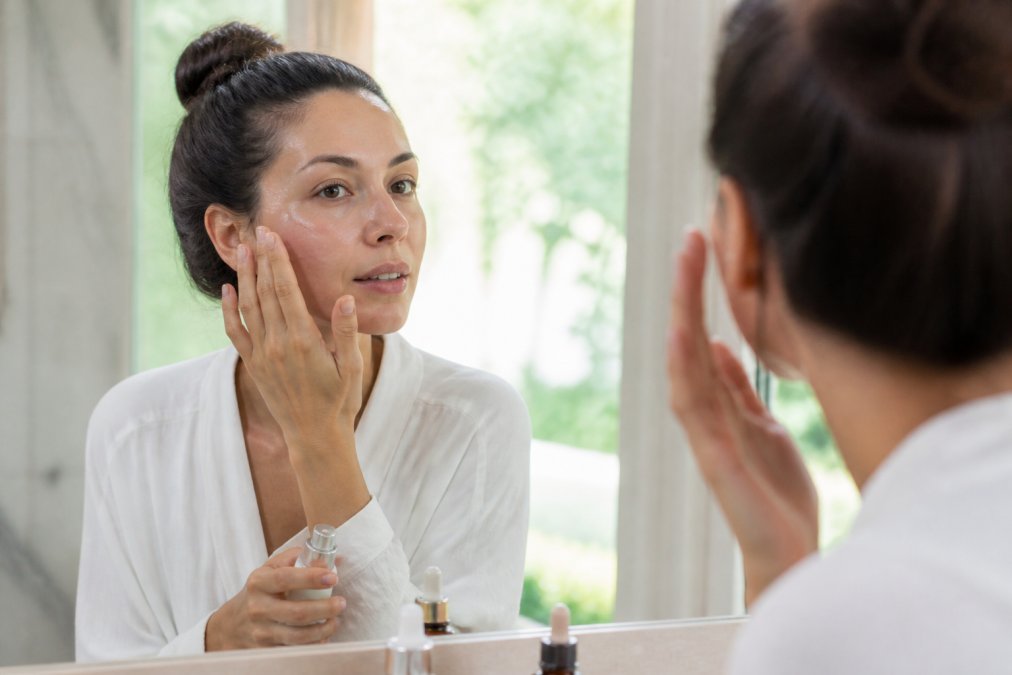
Apply Serums by Zone
Serums offer the most targeted way to balance oily t-zone and dry cheeks. For the T-zone, apply a niacinamide serum to regulate sebum production and support oil control.
For the cheeks, switch to a serum rich in ceramides or squalane to replenish the lipid barrier. This layering technique ensures active ingredients are delivered where needed most. Always apply serums to slightly damp skin to enhance absorption. If you are new to a product, patch test on your jawline for a few days before applying it to your entire face.
Step 3: Use Multi-Masking for Combination Skin
Multi-masking for combination skin is the most efficient way to address conflicting needs in a single session. This technique involves applying a clay mask to the T-zone to absorb excess oil, while simultaneously applying a hydrating mask to the cheeks to replenish moisture.
The clay mask should contain ingredients like kaolin or bentonite to target oil control. For the cheeks, choose a mask with soothing botanicals and barrier-supporting lipids. Leave both masks on for the recommended time, usually 10 to 15 minutes, then rinse with lukewarm water. This approach prevents the over-drying of a full-face clay mask and the congestion of a rich hydrating mask on the T-zone.
Step 4: The Best Skincare Routine for Combination Skin
Establishing the best skincare routine for combination skin requires a consistent sequence that respects the needs of both zones. A simple, effective routine is more sustainable than a 10-step regimen. The core structure should be: cleanse, tone, treat, moisturize, and protect.
In the morning, use your gel-based cleanser, followed by a pH-balanced toner. Apply a vitamin C serum for antioxidant protection if your skin tolerates it, then your zone-specific moisturizers. Finish with a broad-spectrum sunscreen of at least SPF 30.
In the evening, double cleanse if you wear makeup or sunscreen. Follow with your targeted serums and a night cream. For the T-zone, you might skip the night cream entirely or use a very light gel; for the cheeks, a slightly richer formula supports overnight barrier repair. Consistency is key; results typically appear within four to six weeks.
| Routine Step | T-Zone Focus | Cheek Focus | Frequency |
|---|---|---|---|
| Cleanser | Gentle, pH-balanced gel | Same cleanser, less friction | AM & PM |
| Serum | Niacinamide for oil control | Ceramide or squalane for barrier repair | AM & PM |
| Moisturizer | Light gel or skip in PM | Richer cream or oil-infused balm | AM & PM |
| Mask | Clay-based | Hydrating sheet or cream | 1-2 times weekly |
Step 5: Exfoliate to Balance Oil and Dryness
Exfoliation is critical to balance oily t-zone and dry cheeks, but it must be approached with caution. Over-exfoliation damages the lipid barrier, leading to increased TEWL and reactive sebum production. The goal is to remove dead skin cells and prevent pore congestion without stripping the skin.
For combination skin, a chemical exfoliant is generally preferable to physical scrubs, which can cause micro-tears. The key is to use different acids on different zones and to monitor your skin's response carefully.
Salicylic Acid for the T-Zone
Salicylic acid is a beta-hydroxy acid (BHA) that is oil-soluble, making it ideal for penetrating the sebum-filled pores of the T-zone. It dissolves the intercellular bonds between dead skin cells and breaks down sebum. In over-the-counter formulations, it is typically available at concentrations between 0.5% and 2%; most dermatologists recommend starting at 1% or lower.
The pH of the product matters significantly. Salicylic acid is most effective at a pH between 3 and 4, where it remains in its un-ionized form and can penetrate the stratum corneum. Many leave-on toners and serums are formulated in this range, but some cleansers are buffered to a higher pH and provide minimal exfoliating benefit.
Apply salicylic acid only to the T-zone, forehead, nose, and chin, using a cotton pad or your fingertips. Avoid the cheeks entirely, as BHA can be drying on areas with a thinner barrier. Start with two nights per week, then increase to every other night if your skin tolerates it. If you are also using retinol or other active ingredients, alternate nights to avoid over-exfoliation.
Polyhydroxy Acids and Lactic Acid for the Cheeks
For the cheeks, choose a polyhydroxy acid (PHA) like gluconolactone or lactobionic acid, or a very low concentration of lactic acid (around 5% or less). PHAs are larger molecules than AHAs, meaning they penetrate more slowly and are less irritating. They also have humectant properties, making them suitable for dry, sensitive areas.
Lactic acid, at low concentrations, functions similarly. It is a naturally occurring humectant that helps the stratum corneum retain moisture while gently dissolving dead skin cells. Apply these only to the cheeks, avoiding the T-zone.
Frequency and Timing
Exfoliation frequency should be limited to one to two times per week to start. A common pattern is to exfoliate the T-zone with salicylic acid on Monday and Thursday, and the cheeks with a PHA or lactic acid on Tuesday and Friday, leaving the remaining days for barrier repair. This staggered approach prevents over-exfoliation while still addressing both zones' needs.
If you notice increased flakiness, redness, or a stinging sensation when applying moisturizer, reduce frequency and focus on barrier repair. These are signs you have compromised the stratum corneum. Give your skin a week of gentle cleansing and ceramide-rich moisturizers before resuming exfoliation.
Seasonal Shifts and Makeup: Adjusting Your Approach
The balance between your T-zone and cheeks is not static; it changes with the seasons. In humid summer months, sebum production increases, so you may need a lighter moisturizer on the cheeks and more frequent exfoliation of the T-zone. During winter, cold air and indoor heating increase dryness, requiring a richer moisturizer on the cheeks and reduced exfoliation frequency.
Makeup compatibility also plays a role. Heavy, matte foundations can cling to dry patches on the cheeks, while dewy formulas can exacerbate shine in the T-zone. Use a mattifying primer only on the nose and forehead and a hydrating primer on the cheeks. At the end of the day, remove makeup thoroughly to prevent pore congestion, but follow with a gentle cleanser to avoid stripping the skin.
Common Mistakes That Worsen Imbalance
Many individuals inadvertently worsen their condition by treating their skin as a single entity. One of the most common mistakes is using harsh "anti-acne" washes all over the face, which strips the cheeks and compromises the lipid barrier, leading to a cycle of dehydration where the skin produces more oil to compensate.
Another frequent error is skipping moisturizer on the T-zone entirely in an attempt to control oil. This backfires, as the skin becomes dehydrated and overproduces sebum. Instead, use a light, water-based moisturizer or a niacinamide serum on the T-zone. Ignoring sunscreen is also critical, as UV damage impairs the skin barrier. Finally, introducing too many new active ingredients at once can overwhelm sensitive skin.
Balancing these two opposing skin conditions requires patience and a willingness to adapt your routine based on your skin's daily needs. At Dehaz Skincare, we understand that achieving visible skin refinement means respecting the unique physiology of each facial zone. Our esthetician-developed formulations unite rare botanicals with high-performance active ingredients to support skin balance and lasting vitality.
Frequently Asked Questions
Is it normal to have an oily T-zone and dry cheeks at the same time?
Yes, it is the defining trait of combination skin. It occurs because the T-zone has a higher density of sebaceous glands, leading to overproduction of sebum, while the cheeks have fewer of these glands and a weaker lipid barrier, making them prone to dehydration. This imbalance is often genetic but can be aggravated by harsh cleansers or weather changes. Treating the two zones differently is the most effective way to manage their distinct needs.
Can botanical skincare help regulate sebum production?
Certain botanical ingredients can help support a balanced complexion. Niacinamide, often derived from plants, is known for its ability to regulate sebum production while supporting barrier repair. Other botanicals like green tea extract offer antioxidant benefits that can help calm an overactive T-zone. When choosing products, look for formulations that combine these extracts with hydrating agents to address both oily and dry areas without stripping the skin.
How often should I exfoliate if I have combination skin?
For most combination skin types, exfoliating two to three times per week is sufficient. Over-exfoliation can strip the lipid barrier, leading to increased oil production in the T-zone and more flakiness on the cheeks. Focus on gentle chemical exfoliants like salicylic acid, which can help clear pore congestion in the T-zone. Avoid physical scrubs, as they can create micro-tears and worsen sensitivity on drier patches.
What ingredients should I avoid if I have combination skin?
Avoid harsh sulfates found in foaming face washes, as they can strip natural oils and trigger excess sebum production. Heavy, oil-infused creams can clog pores in the T-zone, while high concentrations of denatured alcohol can worsen cheek dryness. Instead, look for pH-balanced, non-comedogenic products. Ingredients like hydrating hyaluronic acid and niacinamide are generally safe, but always patch test new products to check for skin sensitivity.
