

Saffron Perfume Explained: How Rose, Cardamom and Black Pepper Shape NADIRAH Eau de Parfum
Saffron in perfume smells warm, leathery-soft and faintly honeyed, with a dry, almost hay-like edge that keeps it from turning sweet. Most of that character comes from a single aroma molecule, safranal, which forms as the threads are dried. In a well-built saffron perfume, other materials shape how the spice behaves: rose rounds it, cardamom lifts it, black pepper sharpens the first few minutes. That is exactly the cast of NADIRAH Eau de Parfum, and it makes a good case study in how one rare ingredient can carry an entire fragrance.
What Is Saffron, and Why Does It Smell the Way It Does?
Saffron is the dried stigma of the autumn-flowering crocus, Crocus sativus. Each violet bloom holds just three crimson threads, and they are still picked and separated by hand. A 2021 review in Molecules puts the figure at roughly 150,000 flowers for a single kilogram of dried saffron, which goes a long way toward explaining its price.
Three compounds give saffron its identity. Crocin supplies the golden-red color that bleeds into water. Picrocrocin is the main source of its bitter taste. And safranal is the scent. The same review describes safranal as the major aroma component, accounting for somewhere between 30 and 70 percent of saffron's volatile fraction, out of more than a hundred volatile compounds identified in total. Fresh stigmas barely smell of anything; safranal develops from picrocrocin during drying and storage, through enzymatic activity and gentle heat. In other words, the aroma perfumers prize is something the harvest has to coax out.
On skin, that translates into a scent that reads as both spice and texture. Perfumers often describe saffron as suede-like or leathery, warm but not edible, with a slightly metallic, iodine-tinged brightness at the top. It is a note that tends to sit close and glow rather than shout.
Inside NADIRAH: A Saffron Perfume Built on Rose, Cardamom and Black Pepper
NADIRAH takes its name from the Arabic for rare or precious, and the composition is organized around saffron from start to finish. The listed notes are short and deliberate: saffron, rose, cardamom and black pepper. According to the product page, the opening pairs saffron with cardamom and black pepper, rose rises at the heart, and the saffron accord returns in the base, settling into a soft, still-warm finish. The house describes it as "threads of silk and fire," worn close to the skin rather than projected across a room.
What makes the structure interesting is that saffron appears at both ends. Many spice-led fragrances use their headline ingredient as a fleeting top note. Here it frames the whole wear, so the rose and spices feel like they are being wrapped into the saffron rather than replacing it.
Cardamom: the cool lift
Cardamom is one of the few spices with a price tag in saffron's neighborhood; a 2025 study in Croatica Chemica Acta calls it one of the most expensive spices in the world after saffron and vanilla. Its essential oil is dominated by α-terpinyl acetate, which made up between roughly 36 and 62 percent of the samples analyzed, alongside 1,8-cineole in widely varying amounts and smaller shares of linalool and α-terpineol. That combination is what gives cardamom its paradox in perfumery: aromatic and green-cool on first sniff, then soft and almost floral. Next to saffron, it opens the composition up and keeps the warmth from feeling heavy.
Black pepper: brightness without heat
Black pepper in a fragrance smells nothing like the burn on your tongue. The pungency of pepper comes from compounds that barely evaporate, so what reaches the nose is the dry, woody, faintly citrus sparkle of its volatile oil. In NADIRAH it works as punctuation, giving the opening a crisp edge before the rose arrives.
Rose: the soft heart
Rose is the classic partner for saffron across the perfumery traditions of North Africa, the Middle East and Persia, and the chemistry suggests why the two cooperate so well. A 2023 analysis of industrial rose oils found citronellol to be the largest single component of Rosa damascena oil, with geraniol and nerol among the other principal alcohols, all described as having a rose-like odor. Interestingly, close to a third of the damask rose oil in that study consisted of waxy hydrocarbons that contribute little scent of their own but are regarded as markers of quality. Rose brings a fresh, slightly lemony softness that smooths saffron's leathery facets, which is why NADIRAH's heart feels quieter and more elegant than its opening.
How to Wear a Saffron Eau de Parfum
Because saffron is a close-wearing note, placement matters more than quantity. A few practical habits help a perfume like NADIRAH show its full arc:
- Apply to warm, moisturized skin. Fragrance holds better on skin that is not dry, which is the reasoning behind applying perfume after a bath or after body care. Our guide to making perfume last longer through fragrance layering covers this in more detail.
- Choose pulse points you will not rub. Inner wrists, the base of the throat and behind the ears work well. Rubbing wrists together mostly blurs the top notes, which in NADIRAH means losing the cardamom and pepper sooner.
- Give it time. Judge a saffron perfume after twenty or thirty minutes, once the rose heart has come forward. The opening and the drydown are noticeably different.
- Think evening and cooler weather. Warm, sensual compositions tend to read best in the evening and in autumn and winter, and the product page positions NADIRAH for evening and special occasions.
Layering NADIRAH With Its Perfume Body Serum
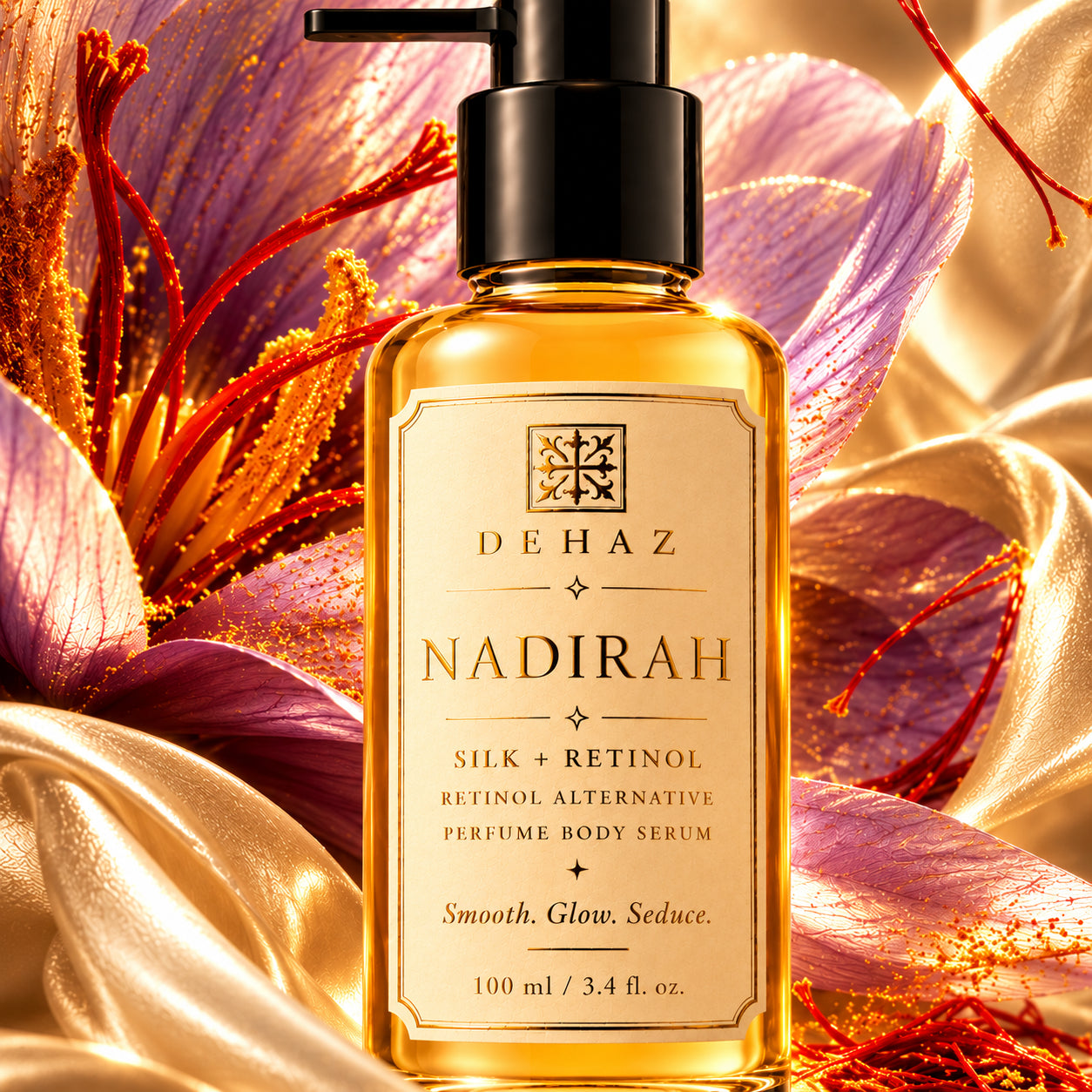
The NADIRAH page recommends layering the eau de parfum with the NADIRAH Silk + Retinol Alternative Perfume Body Serum for a longer-lasting scent trail. The pairing is logical as well as pretty. The body serum is an oil-based formula built on jojoba, saffron, rosehip, cacay and bakuchi oils with hydrolyzed silk, elastin and vitamin E, scented with its own Safran Veil fragrance. An oil layer gives the eau de parfum something to cling to, while the serum's saffron oil echoes the spice at the center of the perfume.
The serum itself is a 100 ml body treatment meant for daily use. Massage it over clean, slightly damp skin after bathing with long, sweeping strokes, let it settle, then mist the eau de parfum on pulse points. Silk and elastin proteins act as conditioning, film-forming ingredients, and the result is skin that feels soft and polished while carrying a quiet veil of scent. It is a particularly nice ritual for the colder months, when body skin tends to feel rough and perfume seems to fade faster.
Saffron on the Skin as Well as in the Bottle
Saffron's appeal is not limited to fragrance. The same carotenoids that give the threads their color, crocin and crocetin, are studied for their antioxidant activity, which is why saffron extract appears in facial oils designed around radiance. If you want to explore that side of the ingredient, our article on saffron in skincare looks at it in depth.
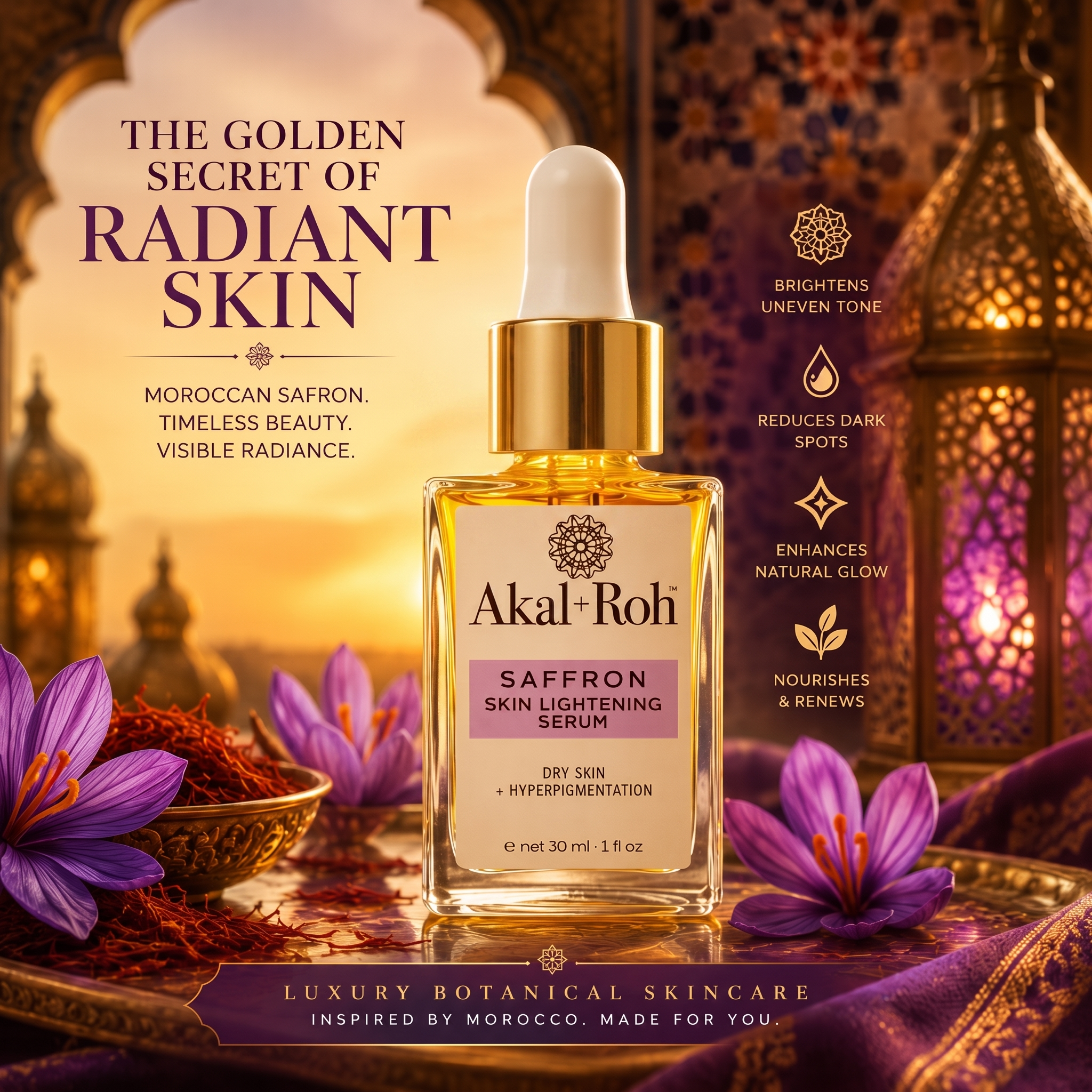
For a face ritual that shares NADIRAH's golden mood, the Akal+Roh™ Saffron Skin Illuminating Serum is a lightweight oil-serum in which saffron flower extract sits in safflower seed oil alongside sea buckthorn, buriti, rosehip and osmanthus flower extract. The directions call for two to four drops pressed into cleansed skin morning and evening, followed by moisturizer, with sunscreen during the day. It is skincare first, but the warm, apricot-floral aroma of osmanthus and saffron makes it a fitting companion on the evenings you wear the perfume.
Where NADIRAH Sits Among DEHAZ Fragrances
Each DEHAZ eau de parfum is built around a distinct botanical story. If NADIRAH is saffron and rose, AMANDE SOUVERAINE explores almond, ambrette and tonka, SÈVE leans into vetiver, cedarwood and black pepper, and NOUR AL ZAHR celebrates Moroccan orange blossom and neroli. Black pepper appears in both NADIRAH and SÈVE, which shows how a single material can play very different roles: a dry sparkle over woods in one, a crisp frame for saffron in the other.
Frequently Asked Questions About Saffron Perfume
What does saffron smell like in perfume?
Saffron reads as warm, soft and slightly leathery, with a honeyed, hay-like dryness and a faint metallic brightness. Its main aroma molecule, safranal, forms as the threads are dried, which is why dried saffron smells far stronger than the fresh flower.
What does NADIRAH Eau de Parfum smell like?
NADIRAH opens with saffron, cardamom and black pepper, moves to a rose heart, and settles into a soft saffron base. It is warm and sensual rather than sharp, and designed to wear close to the skin.
Is saffron perfume better for day or evening?
Saffron can be worn any time, but warm saffron and rose compositions like NADIRAH tend to feel most at home in the evening and in cooler months, when a closer, more enveloping scent suits the setting.
How do I make a saffron perfume last longer?
Apply it to moisturized skin. Layering NADIRAH Eau de Parfum over the NADIRAH Perfume Body Serum, as the product page recommends, gives the fragrance an oil base to hold onto. Spray on pulse points and avoid rubbing.
Why are saffron and rose paired so often?
Rose's citronellol, geraniol and nerol bring a fresh, rounded floral quality that softens saffron's leathery dryness, while saffron gives rose depth and warmth. The pairing has a long history in perfumery across North Africa, the Middle East and Persia.
Explore DEHAZ
NADIRAH is a reminder that the most memorable fragrances often come down to a handful of well-chosen materials. If saffron's quiet warmth appeals to you, start with the NADIRAH Eau de Parfum, and consider its body serum for a layered ritual.
For wholesale, email a picture of your professional license to Info@dehazskincare.com.
References
- Cid-Pérez TS, Nevárez-Moorillón GV, Ochoa-Velasco CE, Navarro-Cruz AR, Hernández-Carranza P, Avila-Sosa R. The Relation between Drying Conditions and the Development of Volatile Compounds in Saffron (Crocus sativus). Molecules. 2021;26(22):6954. doi:10.3390/molecules26226954
- Dobreva A, Nedeltcheva-Antonova D. Comparative Chemical Profiling and Citronellol Enantiomers Distribution of Industrial-Type Rose Oils Produced in China. Molecules. 2023;28(3):1281. doi:10.3390/molecules28031281
- Blažeković B, Čiča L, Kindl M, Vladimir-Knežević S. Content and Chemical Composition of Essential Oil from Cardamom (Elettaria cardamomum (L.) Maton). Croatica Chemica Acta. 2025;98(3):185–193. doi:10.5562/cca4178
Disclaimer: DEHAZ Apothecary Skincare® products are cosmetic products and are not intended to diagnose, treat, cure, or prevent any disease or medical condition. Product information is provided for cosmetic and educational purposes only and is not a substitute for medical advice. Always review the complete ingredient list before use, particularly if you have known allergies or sensitivities. Discontinue use if irritation occurs. If you have a medical condition, known allergy, or concerns regarding the suitability of a product for your skin, consult an appropriate healthcare professional before use.
